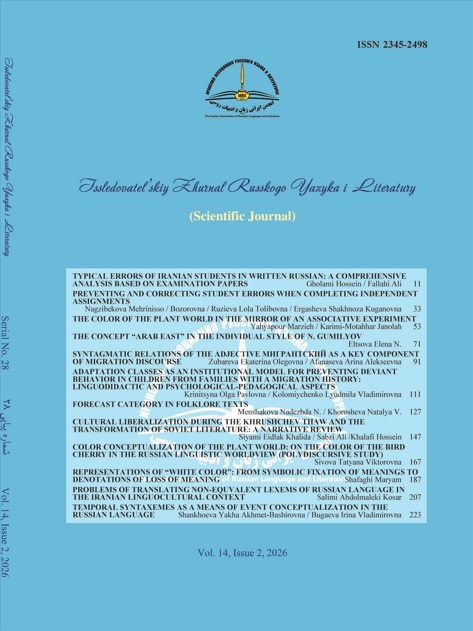
PROBLEMS OF TRANSLATING NON-EQUVALENT LEXEMS OF RUSSIAN LANGUAGE IN THE IRANIAN LINGUOCULTURAL CONTEXT
DOI:
https://doi.org/10.66224/IARLL.28.11Keywords:
Non-Equivalent Vocabulary, Translation Transformations, Culturally Specific Vocabulary, Realities, Translation Strategies, Russian Language, Persian Language, Intercultural Communication, LacunarityAbstract
The translation of non-equivalent lexical units is a complex cognitive-heuristic process that requires the translator to integrate deep linguistic competencies with extensive cultural background knowledge. Adequately conveying the semantics of non-equivalent vocabulary is a key factor in successful intercultural communication and the mutual enrichment of linguistic systems. This study examines the current challenges of translating non-equivalent vocabulary of the Russian language in the specific conditions of the Iranian linguacultural context. The paper classifies and systematically analyzes the main types of non-equivalent units and proposes scientifically substantiated strategies for their translation into Persian. Particular emphasis is placed on culturally marked vocabulary and realities, the interpretation of which poses the greatest challenges in the professional training of Iranian translators. The object of this study is non-equivalent vocabulary of the Russian language, and the subject is the specifics and challenges of its translation in the Iranian linguistic environment. The relevance of this study stems from the need to improve linguodidactic methods that take into account the ethnocultural specifics of translating lacunary units. The aim of this article is to comprehensively analyze the specifics of rendering Russian non-equivalent lexemes in the educational environment of Iranian universities. The objectives of the study include the typology of non-equivalent lexemes, the identification of interference errors and difficulties encountered by Iranian students, and the development of translation algorithms for teaching Russian as a foreign language (RFL). The study's material includes an analysis of translation transformations in student papers, as well as the results of a survey of teachers and students specializing in Russian. The scientific novelty lies in the fact that for the first time, within the framework of comparative Russian and Iranian studies, a multifaceted analysis of non-equivalent vocabulary has been conducted, taking into account the psycholinguistic characteristics of the Iranian audience. The practical significance of the study lies in the possibility of implementing the obtained results in the preparation of textbooks and lexicographic sources.
Extended Abstract
This research examines the challenges of translating non-equivalent lexical units from Russian to Persian in the Iranian linguacultural context, proposing scientifically substantiated translation strategies. The study is based on content analysis of student translations and survey results from teachers and students specializing in Russian. The research identifies five main categories of non-equivalent lexical units and evaluates the effectiveness of various translation strategies.
The first category, "realities" (ethnographic realities), comprises lexemes naming unique objects of material and spiritual culture, such as матрешка (matryoshka), блины (blini), квас (kvas), лапти (bast shoes), and сарафан (sarafan). These objects do not exist in Iranian material culture, requiring strategies that preserve cultural specificity while making concepts accessible to Persian-speaking readers. The second category, culturally specific vocabulary and phraseology, includes words and idioms whose semantics are linked to Russian history and traditions, such as бить баклуши (to play the fool), Масленица (Maslenitsa), and Святки (Christmastide).
The third category, "Sovietisms" and historicisms, includes lexemes reflecting Soviet-era realities: совет, колхоз, перестройка, хрущевка, коммуналка. For Iranian students, these represent a "foreign" history requiring contextual understanding. The fourth category, lexical lacunae, comprises "empty spaces" in the Persian lexical system—concepts with no equivalent at all, such as gastronomic terms (борщ, щи) and cultural institutions. The fifth category, authorial neologisms (occasionalisms), includes words created for specific artistic purposes, such as Nabokov's innovative color terms or Mayakovsky's громадье (enormity), requiring creative translational solutions.
The research evaluates five main translation strategies. Transcription/transliteration (preserving sound or graphic form) is recommended for preserving exotic color, as in балалайка → بالالایکا (balalaika). Calquing (morpheme-by-morpheme translation) is effective for transparent internal forms, as in небоскреб → آسمانخراش (âsemân-kharâsh, sky-scraper). Descriptive translation is unavoidable when no analog exists, requiring expanded explanations such as валенки → چکمههای نمدی سنتی (chakmehaye namadi sonnati, traditional felt boots). Approximate translation (functional analog) seeks culturally close concepts, as in дача → ویلای ییلاقی (vilaye yeylaghi, country villa), capturing the functional meaning despite cultural differences. Contextual translation depends on the word's environment and requires deep understanding of both linguistic and situational contexts.
The study demonstrates that Iranian students' main difficulties stem from conceptual lacunarity and the absence of background cultural, historical, and social knowledge rather than purely linguistic competence issues. The most effective pedagogical approach combines multiple strategies with extensive cultural commentary, including footnotes with detailed historical and cultural explanations for lexemes such as хрущевка (Khrushchev-era housing), пряник (gingerbread), and самовар (samovar). The research contributes to improving linguadidactic methodologies that account for the ethnocultural specificity of translating lacunar units, with practical significance for developing textbooks and lexicographic sources for Persian-speaking students of Russian.
Downloads
Published
How to Cite
Issue
Section
License
Copyright (c) 2026 Issledovatel'skiy Zhurnal Russkogo Yazyka I Literatury

This work is licensed under a Creative Commons Attribution 4.0 International License.

"Creative Commons Attribution 4.0 International (CC-BY 4.0)"