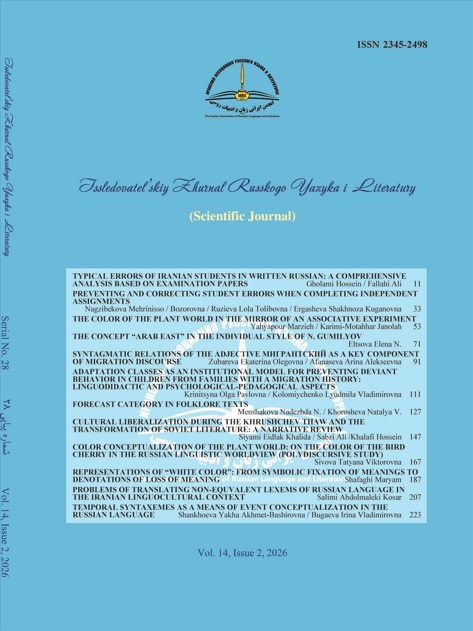
REPRESENTATIONS OF “WHITE COLOR”: FROM SYMBOLIC FIXATION OF MEANINGS TO DENOTATIONS OF LOSS OF MEANING
DOI:
https://doi.org/10.66224/IARLL.28.10Keywords:
Color Semiotics, White Color, Semantic Silence, Symbolic Power, Intercultural ComparisonAbstract
The article examines the semantic and symbolic functioning of the color white in linguistic and cultural systems, drawing on semiotic, cognitive, and intercultural approaches. White is treated not as a neutral color term, but as a multilayered sign embedded in a network of meanings associated with purity, beginning, sacrality, silence, power, and normativity. Special attention is paid to the paradoxical nature of white as a marker of both the presence and absence of meaning, potential and emptiness. It is shown that white functions as a semiotic regulator of interpretation, creating an effect of neutrality and objectivity while simultaneously participating in the production of symbolically legitimized meanings. The analysis covers fixed expressions, metaphors, and discursive practices in which white operates as an instrument of symbolic power. An intercultural comparison of Persian and Russian traditions reveals differences in the semantic organization of white: in Persian, sacral‑ritual and mythological layers prevail, whereas in Russian, cognitive‑functional and normative ones dominate. The findings confirm the cultural conditioning of color semantics.
Extended Abstract
This research provides a comprehensive semiotic, cognitive, and intercultural analysis of the semantic and symbolic functioning of the color white in linguistic and cultural systems. The central argument is that white should be treated not as a neutral color term but as a multilayered sign embedded in a network of meanings associated with purity, beginning, sacrality, silence, power, and normativity. The study employs a multi-methodological approach combining semiotic analysis, cognitive-linguistic frameworks, and discursive analysis, with materials drawn from corpus and linguacultural sources of the Persian tradition (texts on light symbolism, ritual practices, and the aesthetics of white) and Russian-language scholarly works on the semiotics of silence, color symbolism, and discursive strategies of meaning neutralization.
The research identifies white's paradoxical nature as a marker of both presence and absence of meaning, potential and emptiness, functioning as a semiotic operator that regulates interpretation while creating an effect of neutrality and objectivity. This paradox is explored through the concept of "semantic silence," where white represents a mode of meaning's absence that is not equivalent to empty signification but retains the fundamental possibility of subsequent meaning-making. In Sufi hermeneutics, white relates to deliberate silence where the sign consciously recedes, yielding to unspoken meaning. The Persian linguistic tradition preserves this sacral semantics through expressions such as کاغذ سفید (kaghaz-e sefid, white paper) and صفحه سفید (safeh-ie sefid, white page), positioning white as the sign of beginning without evaluation—a boundary between the sacral hierarchy of light and the cognitive possibility of meaning-making.
The intercultural comparison reveals significant differences between Persian and Russian traditions. In the Persian tradition, sacral-ritual and mythological layers dominate, as exemplified by Zoroastrian practices where white is associated with ritual purity, spiritual clarity, and cosmic order. In Zoroastrian women's ritual symbolism (Yazd tradition), white marks virginity, sacral purity, and connection to the water element and goddess Anahita. The color opposition "white/green" forms a binary model of "maiden/mother": before marriage, brides wore white; on the wedding day, green, symbolizing normative transition to socially and sacrally recognized spousehood. In contrast, the Russian tradition exhibits dominance of cognitive-functional and normative meanings, where white is systematically associated with moral norms and "correct" world order (white light, white person, to live by white).
The analysis of white as an instrument of symbolic power reveals how apparent semantic transparency masks active ideological functions. The high degree of whiteness in visual fields creates an effect of symbolic neutrality and "transparency" that structures the horizon of permissible meanings. In Persian political discourse, expressions such as پرچم سفید (white flag), سپیدسازی (semantic "whitening"), and انقلاب سفید (White Revolution) use white as a means of symbolic simplification and normative "cleansing" of socially conflictual processes. Critical analysis challenges the notion of white's semantic neutrality, revealing it as an active semiotic agent of control and legitimation. The study confirms the cultural conditioning of color semantics, demonstrating that the meanings of white vary substantially depending on cultural models and the organization of linguistic consciousness, functioning as a key instrument of symbolic power organizing the space of permissible interpretation.
Downloads
Published
How to Cite
Issue
Section
License
Copyright (c) 2026 Issledovatel'skiy Zhurnal Russkogo Yazyka I Literatury

This work is licensed under a Creative Commons Attribution 4.0 International License.

"Creative Commons Attribution 4.0 International (CC-BY 4.0)"