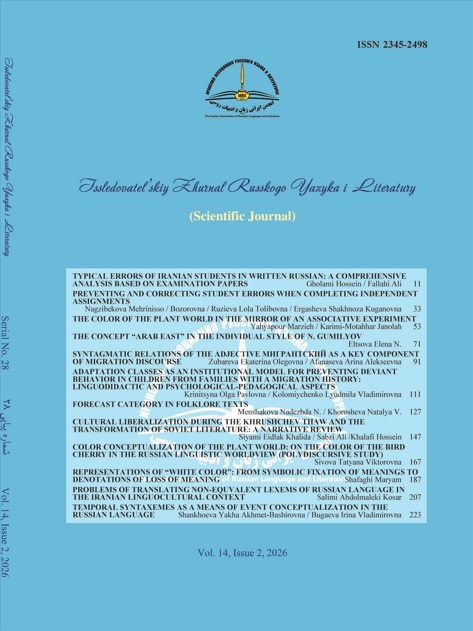
CULTURAL LIBERALIZATION DURING THE KHRUSHCHEV THAW AND THE TRANSFORMATION OF SOVIET LITERATURE: A NARRATIVE REVIEW
DOI:
https://doi.org/10.66224/IARLL.28.8Keywords:
Khrushchev Thaw, Soviet Literature, De-Stalinization, Socialist Realism, Cultural LiberalizationAbstract
Аrticle presents a qualitative analysis of scholarly interpretations of the "Khrushchev Thaw" (mid-1950s to mid-1960s) and its impact on Soviet literature. The subject of the study is the interrelationship between cultural liberalization, literary institutions, and the transformation of artistic expression during the "Thaw"—a period characterized as a structurally unstable and politically constrained form of the restructuring of Soviet culture. Drawing on contemporary and historical literary scholarship, the article examines the transition from the ideological rigidity of the Stalin era—characterized by the dominance of Socialist Realism, institutional control, and the suppression of individual self-expression—to the more flexible, yet still constrained, cultural environment that emerged following Stalin’s death in 1953 and Nikita Khrushchev’s denunciation of the cult of personality in 1956. The article argues that the "Thaw" fostered significant changes in Soviet literature, including the abandonment of the principle of "conflictlessness," the return of the lyrical "I," a heightened interest in historical trauma and everyday life, and the emergence of more ambiguous narrative forms and morally complex characters. The study revealed that the cultural significance of the "Khrushchev Thaw" lay not in the elimination of ideological control, but in a partial re-evaluation of the function of literature within Soviet culture and the formation of a fragile model of "permitted dissent".
Extended Abstract
This research presents a qualitative narrative review of scholarly interpretations of the "Khrushchev Thaw" (mid-1950s to mid-1960s) and its impact on Soviet literature, examining the interrelationship between cultural liberalization, literary institutions, and the transformation of artistic expression. The study is based on a corpus of twenty academic works addressing various aspects of Soviet cultural and literary development during de-Stalinization, organized around three key dimensions: transformation of cultural policy after Stalin's death; institutional structures shaping literary production; and scholarly interpretations of thematic, narrative, and moral changes in Thaw-era literature.
The research methodology employs qualitative narrative review combined with interpretive synthesis, analyzing scientific interpretations of Soviet literature's transformation during the Thaw. The authors organize their analysis chronologically, distinguishing between the early phase of cultural liberalization (1953–1956), the peak period following the 20th Party Congress (1956–1962), and the tightening after the Manege Exhibition of 1962, culminating in post-1964 cultural restrictions.
The article establishes that Stalin's death (March 5, 1953) was the crucial turning point, followed by institutional reforms including the creation of the Ministry of Culture in 1953. The 20th Party Congress of 1956, where Khrushchev delivered his "secret speech" condemning the cult of personality, served as the main catalyst. As N. Condee argues, this created a "crisis of legitimate succession" where exposure of Stalin left the cultural establishment without its traditional patriarchal authority, allowing for partial rehabilitation of previously banned authors and renewed interest in foreign literary traditions.
The research identifies significant thematic transformations: abandonment of the "conflictlessness" principle, return of the lyrical "I," heightened interest in historical trauma and everyday life, emergence of ambiguous narrative forms and morally complex characters. The thematic shift allowed writers to address previously suppressed realities, including the Gulag system (Solzhenitsyn's One Day in the Life of Ivan Denisovich) and the Holocaust (Babi Yar poetic responses). The emergence of "village prose" (Rasputin, Astafiev) sought to revive traditional moral values, while the "second discovery" of Western literature provided access to artistic worlds free from ideological clichés.
The analysis of subjectivity transformation reveals the restoration of the lyrical "I" through the "Sixties" (shestidesyatniki) generation, introducing a new typology of heroes including the "loser hero" and skeptic. Gender dimension analysis shows emotional expression increasingly transferred to female characters. The study also examines structural contradictions: cultural liberalization remained selective and reversible, with periods of openness followed by sudden hardening of disciplinary control. The authors conclude that the Thaw's significance lay not in eliminating ideological control but in partially re-evaluating literature's cultural function, creating a fragile model of "permitted dissent" that required constant, unstable balance between artistic integrity and party ideological loyalty. This equilibrium ultimately proved unsustainable after Khrushchev's removal in 1964.
Downloads
Published
How to Cite
Issue
Section
License
Copyright (c) 2026 Issledovatel'skiy Zhurnal Russkogo Yazyka I Literatury

This work is licensed under a Creative Commons Attribution 4.0 International License.

"Creative Commons Attribution 4.0 International (CC-BY 4.0)"