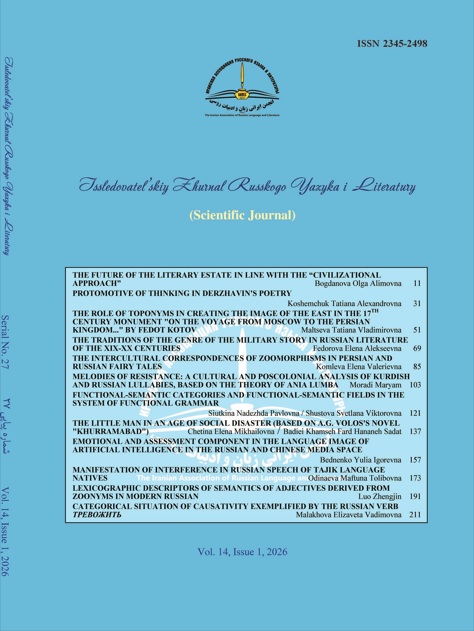
THE FUTURE OF THE LITERARY ESTATE IN LINE WITH THE “CIVILIZATIONAL APPROACH”
Keywords:
Russian Literary Estate, Civilizational Approach, Russian Literature of the Turn of the 20th–21th Centuries, The Estate as a Euro-Asian Phenomenon and a Window into Transcendent Meanings, The Future of the Russian EstateAbstract
In the USSR and in the post-Soviet period are shown. Based on the material of Russian literature at the turn of the 20th–21st centuries, the trends in the development of the literary estate in line with the “civilizational approach” associated with the “great time” (M.M. Bakhtin) of Russian history were revealed for the first time. Based on this methodology, in the process of textual analysis of the works of T.N. Tolstaya, V.G. Sorokin, A.P. Potemkin, Yu.V. Mamleev, V.O. Pelevin, G.S. Yakhina, etc., the conclusion is made that the history of the Russian literary estate is not limited to the imperial period of the 18th – early 20th century, as previously thought, but goes back to Moscow Rus with its Turkic-Slavic socio-cultural symbiosis. At the same time, some authors satirize the “civilizational approach” and the accompanying “estating” of Russia (V.G. Sorokin, V.O. Pelevin), some remain neutral (T.N. Tolstaya, G.S. Yakhina), and others welcome the new civilizational shift (A.P. Potemkin, Yu.V. Mamleev).
Extended Abstract
This article, re-examines the Russian literary estate (усадьба) as a cultural phenomenon, arguing for its continued relevance and future trajectory within the framework of the "civilizational approach." The author challenges the conventional view that the estate was definitively destroyed in the early 20th century, asserting instead that it transitioned into various public forms (museums, sanatoriums, creative communes) during the Soviet era and is now being recreated in new formats in post-Soviet Russia. Bogdanova posits the estate as a universal element of the human cultural code—an archetype traceable to the biblical Eden—that adapts to specific national and civilizational contexts.
The core of the analysis applies a civilizational methodology, informed by the "big time" of Russian history (M.M. Bakhtin), to works of Russian literature from the turn of the 20th–21st centuries. This approach, drawing on the theories of thinkers from Danilevsky and the Eurasianists to Huntington and contemporary Russian scholars like Tsymbursky, views Russia as a distinct civilization shaped by a unique synthesis of Slavic and Turkic influences, Orthodox faith, and its specific geography. Through textual analysis of novels by T.N. Tolstaya, V.G. Sorokin, A.P. Potemkin, Yu.V. Mamleev, V.O. Pelevin, and G.S. Yakhina, the article identifies a key trend: the literary estate is being reimagined not merely as a relic of the imperial 18th–early 20th century period, but as a phenomenon with deeper roots in Muscovite Rus and its Turko-Slavic socio-cultural symbiosis.
The examined literary works reveal diverse authorial stances towards this civilizational shift and the concomitant "estatization" of Russia. Some authors engage in satire and critique: Vladimir Sorokin, in Day of the Oprichnik and The Sugar Kremlin, and Victor Pelevin, in Transhumanism Inc., ironically depict dystopian futures where estate life is resurrected in grotesque, technologically infused forms that mock civilizational narratives. Others maintain a more neutral or ambivalent position: Tatyana Tolstaya’s The Slynx stylizes a post-apocalyptic future with elements of pre-Petrine, Muscovite estate life, while Guzel Yakhina’s Zuleikha Opens Her Eyes presents the estate as a Euro-Asian space of cultural fusion without overt ideological endorsement.
In contrast, a third group of authors welcomes the new civilizational perspective. Yury Mamleev’s Empire of the Spirit passionately advocates for Russia’s spiritual sovereignty as a unique civilization, with the estate space serving as a site for metaphysical discourse. Alexander Potemkin’s Man is Cancelled portrays the construction of a new estate as an experimental ground for creating a "new man," explicitly rejecting Western models and seeking a fresh anthropological beginning.
The article concludes that the future of the Russian literary estate is intrinsically linked to these ongoing civilizational self-definitions. It suggests that the estate will continue to evolve, potentially as a "city-garden" or a high-tech "Northern civilization" settlement, remaining a vital "window into transcendent meanings" and a Euro-Asian phenomenon. Thus, the literary estate is not a closed historical chapter but a dynamic topos whose history extends back to Muscovite Rus and whose future will be shaped by Russia's ongoing civilizational trajectory.
Downloads
Published
How to Cite
Issue
Section
License
Copyright (c) 2025 Issledovatel'skiy Zhurnal Russkogo Yazyka I Literatury

This work is licensed under a Creative Commons Attribution 4.0 International License.

"Creative Commons Attribution 4.0 International (CC-BY 4.0)"