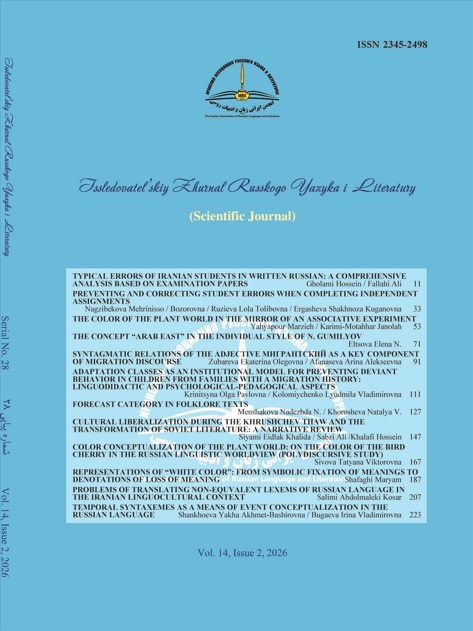
TEMPORAL SYNTAXEMES AS A MEANS OF EVENT CONCEPTUALIZATION IN THE RUSSIAN LANGUAGE
DOI:
https://doi.org/10.66224/IARLL.28.12Keywords:
Temporality, Syntaxeme, Temporal Syntaxeme, Temporative, Terminative, Dimensive, Distributive, Event Conceptualization, Contextual Interpretation, Temporal RelationsAbstract
The article examines temporal syntaxemes as means of contextual interpretation of an event in the Russian language. The aim of the study is to determine the role of temporal syntaxemes in the semantic organization of an event within the structure of an utterance, while preserving their basic temporal meaning. The material of the study consists of a card index of 200 utterances extracted by purposive sampling from the Russian National Corpus. Four groups of temporal syntaxemes are analyzed: temporative, terminative, dimensive, and distributive syntaxemes. It is shown that temporative syntaxemes express the temporal correlation of an event; terminative syntaxemes express a temporal limit; dimensive syntaxemes express temporal duration; and distributive syntaxemes express the recurrence or distribution of an action in time. It is established that resultivity, processuality, boundedness, duration, and recurrence as semantic-syntactic characteristics of an utterance are actualized not by the temporal syntaxeme in isolation, but through the interaction of its basic temporal semantics with lexical-semantic content, predicative structure, and context. In the cognitive aspect, a temporal syntaxeme is considered as a means of actualizing the temporal parameter of an event in its linguistic representation.
Extended Abstract
This research examines temporal syntaxemes as means of contextual interpretation of an event in the Russian language, investigating their role in the semantic organization of events within utterances while preserving their basic temporal meaning. The study is grounded in G.A. Zolotova's theoretical framework defining the syntaxeme as "the minimal unit of the syntactic level, characterized by morphological form, categorical-semantic meaning, and a defined set of syntactic functions." The research is based on a corpus of 200 utterances extracted through purposive sampling from the Russian National Corpus.
The study analyzes four groups of temporal syntaxemes. Temporative syntaxemes express the temporal correlation of an event to another event, moment, or period, including forms such as после разговора (after the conversation), после встречи (after the meeting), после болезни (after the illness), после войны (after the war), перед экзаменом (before the exam), and во время войны (during the war). The analysis demonstrates that while temporative syntaxemes consistently maintain their basic meaning of temporal succession, precedence, or simultaneity, contextual interpretation varies significantly based on predicate structure and lexical content. For example, in "After the conversation with Dontsov, Vera changed," the syntaxeme expresses temporal succession while the semantic nuance of change is activated by the predicate переменилась (changed).
Terminative syntaxemes express a temporal limit, represented by forms such as до вечера (until evening), до утра (until morning), к утру (by morning), and к вечеру (by evening). A crucial distinction emerges between forms with the preposition до (until), which indicate the limit to which an action continues, and forms with к (by), which relate the event to the moment by which a result is formed, a state changes, or a degree of manifestation is reached. This demonstrates that terminative syntaxemes conceptualize the temporal boundary in fundamentally different ways depending on prepositional marking.
Dimensive syntaxemes express the quantitative characteristic of time, duration, or temporal extent, including в течение года (within a year), в течение месяца (within a month), весь день (all day), and несколько дней (several days). Unlike terminative syntaxemes oriented toward a temporal boundary, dimensive syntaxemes activate the temporal volume occupied by the event. Different forms convey duration in different ways: bounded intervals (в течение года, в течение месяца), complete filling of a temporal segment (весь день), and approximately delimited temporal volume (несколько дней). Distributive syntaxemes express recurrence or distribution of an action in time, including каждый день (every day), каждое утро (every morning), по вечерам (in the evenings), and время от времени (from time to time), demonstrating that temporal recurrence is not homogeneous but varies from regular recurrence to episodic recurrence.
The key finding is that resultativity, processuality, boundedness, duration, and recurrence as semantic-syntactic characteristics are actualized not by the temporal syntaxeme in isolation but through interaction with lexical-semantic content, predicative structure, and context. The authors emphasize the importance of distinguishing between the basic temporal semantics of the syntaxeme and its contextual realization—additional semantic-syntactic characteristics emerge at the utterance level through interaction with predicative structure and context. The research contributes to cognitive syntax by demonstrating how temporal syntaxemes function as means of temporal localization and contextual activation of event parameters, revealing their functional-cognitive status as units that actualize the temporal dimension of events in linguistic representation.
Downloads
Published
How to Cite
Issue
Section
License
Copyright (c) 2026 Issledovatel'skiy Zhurnal Russkogo Yazyka I Literatury

This work is licensed under a Creative Commons Attribution 4.0 International License.

"Creative Commons Attribution 4.0 International (CC-BY 4.0)"