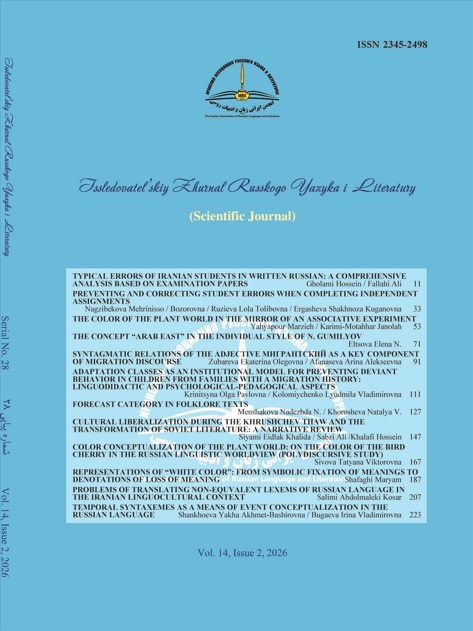
THE CONCEPT “ARAB EAST” IN THE INDIVIDUAL STYLE OF N. GUMILYOV
DOI:
https://doi.org/10.66224/IARLL.28.4Keywords:
N. S. Gumilyov, Acmeism, Arab East, Concept, Eastern Text, Artistic Worldview, VocabularyAbstract
Unlike the Symbolist tradition, the Acmeist poet Nikolay Gumilyov creates not an abstract, but a materially tangible, "thing-like" image of the Arab East, based on personal experience and the principles of Acmeist poetics. In the article based on the poet's works containing Oriental vocabulary, a lexical-semantic and conceptual analysis of the structure and dynamics of the concept "Arab East". Particular attention is paid to the methods of linguistic verbalization of the concept, as well as its philosophical-symbolic and plot-forming significance. The formation of the conceptual field occurs through the artistic reworking of elements of medieval Arabic poetry, as well as Qur'anic and Sufi motifs. The juxtaposition of the concepts poet-dervish marks the deep impact of Sufism upon Gumilyov's poetic philosophy. As a result, the concept "Arab East" is transformed from a geographical reality into a complex religious and philosophical construct, reflecting the evolution of the author's worldview – from romantic exoticism to Acmeist precision in depicting the East and its deep existential comprehension.
Extended Abstract
This research provides a comprehensive lexical-semantic and conceptual analysis of the concept "Arab East" in Nikolay Gumilyov's individual poetic style, examining works containing Oriental vocabulary through the lens of Acmeist poetics. The study is significant because it demonstrates how Gumilyov fundamentally distinguishes himself from Symbolist predecessors by creating a materially tangible, "thing-like" image of the Arab East based on personal travel experience (Egypt, 1908 and 1910; Abyssinia, 1910 and 1913) rather than abstract mysticism. The research employs a complex philological approach combining lexical-semantic and conceptual analysis with contextual and linguacultural methods.
The article establishes that Gumilyov's conceptual field is formed through artistic reinterpretation of medieval Arabic poetry, Qur'anic motifs, and Sufi traditions. The study identifies three main lexical groups: Oriental toponyms (Багдад, Бассора, Каир), poetic terms derived from Arabic and Persian folklore (Синдбад-Мореход, Гафиз), and spiritual-religious vocabulary (Аллах, Пророк, истина). A key finding is the interweaving of the concepts poet and dervish as a marker of Sufism's influence on Gumilyov's poetic philosophy, particularly evident in works such as "Imitation of Persian" (1919), "Persian Miniature" (1919), "The Drunken Dervish" (1919), and the fairy tale "Child of Allah" (1916).
The analysis of the figure of Hafiz (the Persian poet Hafiz Shirazi, c. 1321–1389/1390) reveals multiple semiotic meanings: poet as artist, wise man, enlightened one, and one protected by God. Gumilyov's Hafiz is characterized by the ability to command the dead, serve as keeper of Solomon's ring, and communicate with birds—all markers of prophetic status and access to hidden truths. The study also examines the symbolism of the White Unicorn and Solomon's Ring as testing instruments that reveal the sincerity and purity of intentions.
The article's most significant conclusion is that Gumilyov's Arab East undergoes transformation from geographical reality into a complex religious-philosophical construct reflecting the evolution of his worldview—from romantic exoticism in early work to Acmeist precision and deep existential meaning in his later period. The concept "Arab East" becomes a key element of Gumilyov's artistic worldview, representing Acmeist principles while serving as a space for exploring identity, spirituality, and the nature of poetic creation. The research contributes to our understanding of how Eastern cultural traditions were integrated into Russian Silver Age literature and how Acmeism transformed poetic representations of the Orient.
Downloads
Published
How to Cite
Issue
Section
License
Copyright (c) 2026 Issledovatel'skiy Zhurnal Russkogo Yazyka I Literatury

This work is licensed under a Creative Commons Attribution 4.0 International License.

"Creative Commons Attribution 4.0 International (CC-BY 4.0)"