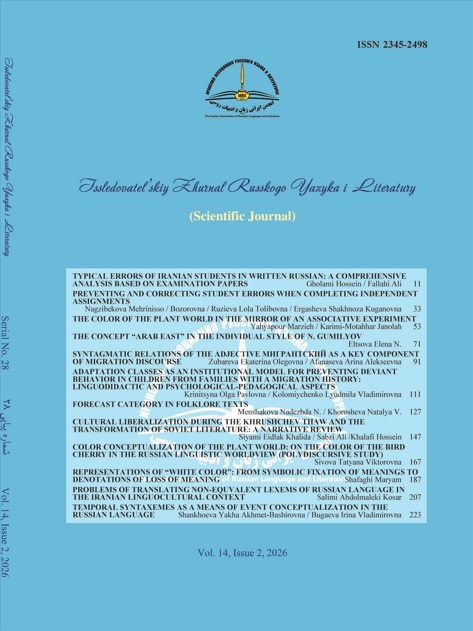
SYNTAGMATIC RELATIONS OF THE ADJECTIVE МИГРАНТСКИЙ AS A KEY COMPONENT OF MIGRATION DISCOURSE
DOI:
https://doi.org/10.66224/IARLL.28.5Keywords:
Migration Linguistics, Migration Discourse, Collocates, Corpus Technologies, Meaning, Dictionary EntryAbstract
This article deals with the compatibility of the lexeme мигрантский as a relevant component of modern society in the context of globalization and international contacts. Ongoing migration flows directly impact language: the intensity of neologization of vocabulary, the emergence of new meanings, the development of polysemy, synonymy, and various syntagmatic relations. On the one hand, migrant is a central category of migration linguistics and, on the other, a key category modeling migration discourse. Collocation analysis is one of the most relevant and in-demand tools for studying the objective associative field of a word, its semantic and stylistic features, and clarifying its core and peripheral meanings. Syntagmatic relations can redefine the conceptual basis of a word, highlighting the relevant aspect in a specific communicative situation. The study is based on The Russian National Corpus. Corpus technologies ensure the reliability of the results, illustrating systemic patterns rather than random occurrences. The study resulted in a dictionary entry explaining all identified phrases containing the lexeme мигрантский.
Extended Abstract
This research investigates the collocational potential of the adjective мигрантский (migrant-related) as a relevant component of contemporary social discourse, employing corpus-based methodology to analyze its syntagmatic relations. The study is situated within the emerging field of migration linguistics, which examines how intensifying migration flows directly impact language through neologization, the emergence of new meanings, and the formation of new syntagmatic relations. The research methodology relies on the Russian National Corpus (RNC), chosen for its capacity to provide reliable, representative data that illustrates systemic patterns rather than random occurrences.
The study analyzed all contexts containing мигрантский in both the main and newspaper subcorpora, identifying 41 collocations not recorded in any existing dictionaries. The authors explain that syntagmatic relations can redefine the conceptual basis of a word, activating the relevant aspect in a particular communicative situation. Following D.O. Dobrovolsky's framework, the research distinguishes between central combinations (which activate the core meaning) and peripheral combinations (which activate more specific or new meanings), with the periphery representing the zone of linguistic experimentation and potential semantic change.
The collocations identified fall into several semantic categories reflecting the multifaceted nature of migration discourse. Physical spaces of migrant concentration include мигрантский анклав, мигрантское гетто, мигрантский квартал, мигрантский район, and мигрантские трущобы. Social dynamics and events are represented by мигрантский бунт, мигрантский митинг, and мигрантский шторм. Institutional and service descriptions include мигрантская школа, мигрантский центр, and мигрантский приют. Economic aspects are captured by мигрантский труд and мигрантская зарплата.
Notably, 14 of the 41 collocations are used in figurative (metaphorical) senses, indicating the rich metaphorical extension of the concept in public discourse. These include мигрантский марафон (migrant marathon), мигрантская икона (migrant icon), мигрантский рай (migrant paradise), мигрантское море (migrant sea), мигрантский отстойник (migrant settling tank), мигрантская прослойка (migrant layer), and мигрантский шторм (migrant storm). The article presents a complete dictionary entry with definitions for each phrase, including illustrative examples from the corpus.
The research also identifies the collocation мигрантская внешность (migrant appearance), which has acquired a culturally loaded meaning in Russian public discourse, referring to physical characteristics stereotypically associated with migrant populations. The study demonstrates that the lexeme мигрантский has developed a complex, multidimensional semantic structure reflecting contemporary societal concerns about migration, integration, and identity. The research concludes that the lexeme demonstrates significant syntagmatic potential, confirming its importance in modern Russian society and linguistic consciousness. The article contributes both descriptive and practical resources for understanding how migration is linguistically constructed in Russian media and public discourse.
Downloads
Published
How to Cite
Issue
Section
License
Copyright (c) 2026 Issledovatel'skiy Zhurnal Russkogo Yazyka I Literatury

This work is licensed under a Creative Commons Attribution 4.0 International License.

"Creative Commons Attribution 4.0 International (CC-BY 4.0)"