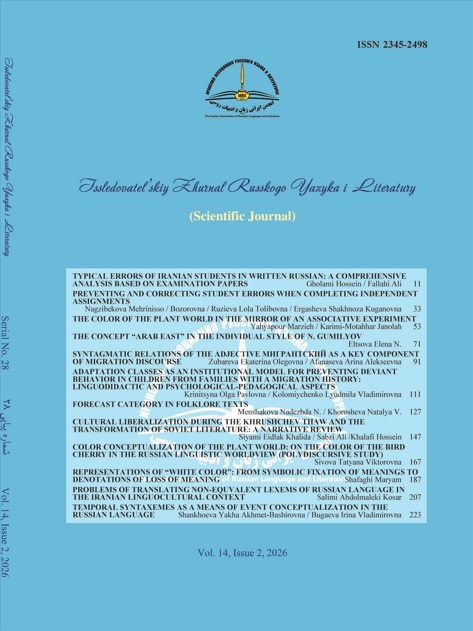
ADAPTATION CLASSES AS AN INSTITUTIONAL MODEL FOR PREVENTING DEVIANT BEHAVIOR IN CHILDREN FROM FAMILIES WITH A MIGRATION HISTORY: LINGUODIDACTIC AND PSYCHOLOGICAL-PEDAGOGICAL ASPECTS
DOI:
https://doi.org/10.66224/IARLL.28.6Keywords:
Children with a Migration History, Foreign Languages, Adaptation Class, Deviant Behavior, Language Adaptation, Sociocultural Integration, Migrant Pedagogy, PreventionAbstract
The article examines the evolution of approaches to the adaptation of minor foreign citizens in the Russian Federation. It substantiates the need to transition from disparate pedagogical practices to an institutional model of adaptation classes, which can serve as a tool for preventing deviant behavior among migrant children. The article highlights two key aspects of the functioning of such classes: linguodidactic (overcoming the language barrier as a major factor in maladaptation) and psychological and pedagogical (compensating for cultural shock and frustration, and fostering positive identity). This issue is particularly relevant from the perspective of migration linguistics, which studies, among other things, the linguistic mechanisms of linguistic tolerance and linguistic conflict. Migrant children are one of the main categories of the migration concept sphere. Based on the analysis of regional practices and scientific research, it has been shown that the systematic work of adaptation classes, which integrates intensive Russian language training, psychological and pedagogical support, and involvement in the culture of the host community, directly correlates with a decrease in the risks of social isolation, conflict, and deviant behavior.
Extended Abstract
This research examines the evolution of approaches to adapting foreign minors in the Russian Federation and substantiates the necessity of transitioning from fragmented pedagogical practices to an institutional model of adaptation classes as a tool for preventing deviant behavior among migrant children. The study is situated within the framework of migration linguistics and migrant pedagogy, addressing two key aspects: the linguodidactic dimension (overcoming the language barrier as the primary factor in maladaptation) and the psychological-pedagogical dimension (compensating for cultural shock and frustration, fostering positive identity formation).
The methodological foundation is a retrospective analysis of scientific studies and pedagogical practices from the 1990s to the present, integrating data from implemented sociocultural adaptation programs across Russian regions. The empirical base includes programs from the scientific school of E.V. Bondarevskaya in southern Russia, projects in Khanty-Mansi Autonomous Okrug, Kaluga and Sverdlovsk regions, and the best practices bank of the Federal Coordination Resource Center at Moscow State University of Psychology and Education. The authors employ analytical generalization, systematization, and comparative analysis of various models.
The research identifies persistent contradictions documented over two decades: the gap between society's need for migrant adaptation and the educational system's unreadiness; the discrepancy between empirical experience and theoretical conceptualization; chronic teacher competency deficits for multi-ethnic environments; and the conflict between linguistic reality and methodological preparedness. The study demonstrates that despite changing scientific paradigms, the core problem remains unchanged: existing educational practice lacks the scientific-methodological tools necessary for effective language, sociocultural, and psychological-pedagogical adaptation.
The article presents a detailed five-block model for adaptation classes: conceptual-normative (grounded in Federal Law No. 544-FZ mandating Russian language testing for foreign children), organizational (defining participants: children, classroom teacher, and team of specialists including speech therapist, psychologist, and social educator), program-target (establishing the goal of constructing a holistic psychological-pedagogical portrait), operational-activity (featuring specially designed programs for intensive Russian language training and cultural familiarization), and diagnostic-monitoring (tracking progress in speech development, social adaptation, and psycho-emotional state).
The study analyzes best practices from various regions, demonstrating that the didactic core comprises courses in Russian as a foreign language and speech development with emphasis on functional literacy for everyday and academic communication. The psychological module addresses cultural shock and frustration through parent education programs, parent-child clubs, and conflict resolution training. The authors highlight mentoring and volunteering as crucial institutional mechanisms where migrant children shift roles from "maladaptive outsiders" to "proactive helpers," fundamentally reducing risks of identity crisis. The research concludes that systematic work of adaptation classes directly correlates with reduced risks of social isolation, conflict, and deviant manifestations, and advocates for institutionalizing this model at the federal level.
Downloads
Published
How to Cite
Issue
Section
License
Copyright (c) 2026 Issledovatel'skiy Zhurnal Russkogo Yazyka I Literatury

This work is licensed under a Creative Commons Attribution 4.0 International License.

"Creative Commons Attribution 4.0 International (CC-BY 4.0)"