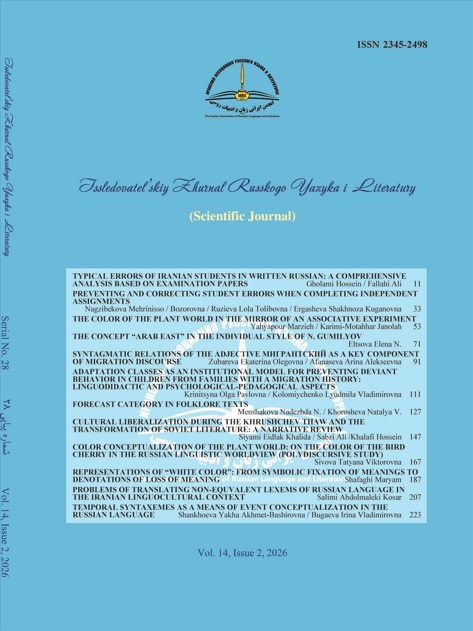
THE COLOR OF PLANT WORLD IN THE MIRROR OF ASSOCIATIVE EXPERIMENT
DOI:
https://doi.org/10.66224/IARLL.28.3Keywords:
Linguistics of Colour, Colour Term, Phytonym, Language Consciousness, Associative ExperimentAbstract
The present article provides an overview of contemporary research directions in the field of color linguistics, which has gained considerable momentum in Russian and Iranian studies (Russian studies and Iranian studies) due to the prominent role of color terms in literature and culture.. Against the backdrop of a review of scientific events dedicated to the study of color currently being held in Russia, Iran, and Belarus, as well as notable recent monographic studies, the article presents a lexicographic project unique to associative color lexicography: T.V. Sivova's Associative Dictionary of Color: The World of Flora (Belarus, Grodno, 2025). Compiled on the basis of a series of directed associative experiments conducted by the author (involving over 1,700 respondents in total), the dictionary reflects a segment of the color conceptual sphere within the floristic domain of the Russian language. The article outlines the concept of the Associative Dictionary of Color, which comprises 160 dictionary entries, provides a detailed description of its three-part structure, and offers examples of how the linguistic material is presented. The Dictionary is of both scholarly interest – for specialists working in lexicography, text linguistics, color linguistics, ethnolinguistics, and psycholinguistics – and practical value, as it can be utilized by professionals in the fields of advertising, branding, and, more broadly, information and communication.
Extended Abstract
This research presents a pioneering lexicographic project in associative color lexicography: T.V. Sivova's Associative Dictionary of Color: The World of Flora (Grodno, 2025). The dictionary is built upon a series of directed associative experiments conducted in 2021–2022 involving over 1,700 respondents—students at Yanka Kupala State University of Grodno—who were asked to provide color associations for 160 stimulus phytonyms (plant names). The study's methodology is significant because it captures not just dictionary definitions of color terms but the actual cognitive associations that native Russian speakers hold about plant colors in their linguistic consciousness.
The dictionary's three-part structure is methodologically innovative. The first part, "From Phytonym to Color Term," comprises 160 entries headed by plant names, each presenting statistical data on the number of color reactions, variety of responses, and frequency of each response. This section reveals the color stereotypes that have formed in everyday linguistic consciousness, showing, for example, that белый (white) is the dominant association for bird cherry (110 responses), followed by фиолетовый (purple, 80 responses). The second part, "From Phytonym to Color Term: Gender Representation," reveals significant gender differences in color naming, confirming that female respondents demonstrate greater variety and nuance in color discrimination. The third part, "From Color Term to Phytonym," is a reverse dictionary with 1,208 entries headed by color terms that appeared as responses, organized by frequency of association.
The article identifies unique color descriptions that reflect individual color worldviews, including горчичный (mustard), пурпурный (purple), багряный (crimson), бронзовый (bronze), and рыжий (reddish) for bird cherry. The study also identifies various methods for refining color impressions: multi-component color composites (зелено-фиолетовый, красно-черный), two-component color chains, descriptive constructions, lexemes with intensity meanings (яркий, светло-), lexemes with implicit color (иней, снег, пена), and lexemes with light/dark semantics (блеск, запылать, потемнеть).
The dictionary's significance extends beyond academic lexicography to practical applications in advertising, branding, design, and information communication. The research demonstrates how color conceptualizations are shaped by cultural memory, linguistic convention, and perceptual experience, contributing to our understanding of both individual and national color worldviews. The article concludes by identifying the functions of color descriptions in literary texts: ontological, species-distinguishing, illustrative-expressive, prototypical, and chronotopic. The chronotopic function is particularly developed, with plant color descriptions participating in constructing both spatial and temporal dimensions of literary texts, including natural space, human-related space, social space, and temporal coordinates such as season, time of day, and historical period.
Downloads
Published
How to Cite
Issue
Section
License
Copyright (c) 2026 Issledovatel'skiy Zhurnal Russkogo Yazyka I Literatury

This work is licensed under a Creative Commons Attribution 4.0 International License.

"Creative Commons Attribution 4.0 International (CC-BY 4.0)"